








In this edition of the EWFM Fact Files, we look at our range of Engineered Swivel Joints.
Swivel Joints or also known as Rotating Joints, allow pipework to articulate or hoses to rotate while helping relieve stress within a fluid transfer system. This movement can reduce hose twisting, pipework stress and the risk of premature equipment failure.
A damaged hose or pipe can result in costly downtime. It can also create a potential safety risk for operators working nearby.
Our Swivel Joints range includes solutions for a wide variety of demanding applications. In this Fact File, we focus on Multiport Rotary Unions, Engineered Swivel Joints, Compact Swivel Joints and Subsea Swivel Joints.
About Our Engineered Swivel Joints
Multiport Rotary Unions
Also known as Multiport Swivel Joints, Multiport Rotary Unions allow multiple flows across a common rotational axis. They can accommodate hydraulics, pneumatics, water, cables, vacuum and other media within a single rotating assembly.
Each Multiport Rotary Union is manufactured to order, allowing the design to meet specific application requirements. Ports can exit radially or axially, while optional leak detection ports and custom mounting arrangements are also available.
Sizes range from 1/8” up to 42”, with construction available in Stainless Steel 316L and Carbon Steel. Other materials can also be considered depending on the application. Designs can accommodate pressures up to 1379 Bar G.
This flexibility has allowed us to produce a wide variety of bespoke Multiport designs for specialist applications.
Engineered Swivel Joints
Engineered Swivel Joints provide reliable rotation in demanding applications involving high loads, pressures or extreme temperatures.
Sizes range from ¾” up to 72” bore. Material options include Carbon Steel, Low Temperature Steel, Stainless Steel, Duplex, Super Duplex and Hastelloy. This wide selection allows the joint to suit different media and operating environments.
A range of end connections is also available. Options include flanged, threaded and weld end connections, alongside specialist connections for individual applications.
Additional features can include steam jackets, leak detection ports, PTFE lining and plated bores. These options allow the Swivel Joint to meet specific process and operating requirements.
Compact Swivel Joints
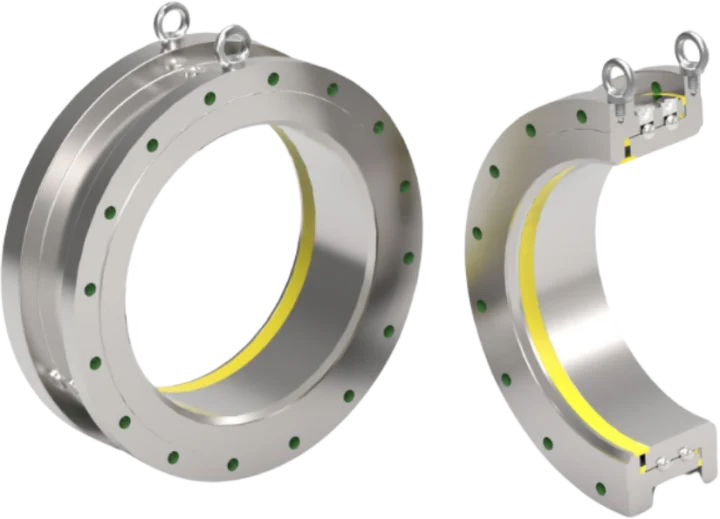
When installation space is limited, Compact Swivel Joints provide rotation within a reduced overall footprint.
The design incorporates both ball and roller bearings to provide strength and reliable rotation. Compact Swivel Joints are typically manufactured around ASME 16.5 150 lb flange dimensions.
Sizes range from 2” to 12”, with Carbon Steel and Stainless Steel options available. The range can handle pressures up to 10 Bar G.
Standard seal options include Nitrile, Fluorocarbon and PTFE. Other seal materials can also be considered to suit specific media or operating conditions.
A variety of flanged, threaded, weld end and specialist connections are available. This makes the Compact Swivel suitable for a range of space-restricted fluid transfer applications.
Subsea Swivel Joints
Subsea Swivel Joints help relieve stress in pipework during subsea installation and laying operations. They reduce bending as equipment is lowered towards the seabed, helping protect the pipework and surrounding equipment.
We have supplied Subsea Swivel Joints for oil and gas applications at depths of up to 3,000 metres. Designs can also accommodate pressures up to 1379 Bar G.
Material options include Carbon Steel, Stainless Steel and Duplex Steel. A range of end connections and seal materials is also available to suit different project requirements.
The design follows ISO 13628 (API 17D) and ISO 10423 (API 6A). Other industry standards can also be accommodated when required.
Classification authorities such as DNV and ABS can review and inspect the design and construction process. This helps ensure the equipment meets the required project standards.
Choosing the Right Swivel Joint
The correct Swivel Joint will depend on the requirements of the individual application. Important considerations include size, media, pressure, temperature, material compatibility, available space and connection type.
More demanding applications may also require specialist materials, seals, linings or additional features. Understanding these requirements at an early stage helps identify the most suitable Swivel Joint configuration.
Explore our full Swivel Joint range for more information on the different options available.
If you have a project or need help selecting the right Swivel Joint, get in touch with the EWFM sales team. We can discuss your application and help identify a suitable solution.
