








Fluid transfer is a critical operation in industries such as Oil & Gas, Chemicals, Food & Beverage, and Pharmaceuticals. Whether you’re handling liquids, gases, or other fluids, the efficiency, safety, and reliability of your processes rely heavily on selecting the right equipment. At EWFM, we specialise in providing high-quality Loading Arm solutions tailored to your unique operational requirements.
In this guide, we’ll explore the key factors to consider when choosing a Loading Arm, dig into the technical detail that determines long-term performance, and answer the questions we’re asked most often, so you can optimise your fluid transfer systems with confidence.
Why Choose Loading Arms Over Hoses?
Loading Arms offer several distinct advantages over traditional hoses:
- Durability: Made from high-quality materials such as stainless steel, aluminium, or carbon steel, Loading Arms are significantly more resistant to wear and tear compared to hoses.
- Long-Term Cost Efficiency: While hoses may be cheaper initially, they often require frequent pressure testing, typically at least twice a year, along with regular replacements. Over time, this can make them more expensive than Loading Arms.
- Safety: Hoses can be cumbersome to handle, difficult to store properly, and pose trip hazards if left unsecured. In contrast, Loading Arms are designed to minimise these risks, offering a safer working environment.
- Operational Efficiency: Loading Arms allow for quicker and more accurate connections, reducing transfer times and enhancing overall operational efficiency.
- Ergonomics: Easier to manoeuvre and control, Loading Arms help reduce operator fatigue and improve workplace ergonomics.
Explore our full range of Loading and Unloading Arms →

Key Factors to Consider When Choosing a Loading Arm
Choosing the right Loading Arm is essential to ensuring safe, efficient, and reliable fluid transfer. It requires careful evaluation of several key factors. Here’s a breakdown of what to consider.
1) Type of Fluid
The characteristics of the fluid being transferred play a crucial role in determining the appropriate Loading Arm. Each fluid type, whether corrosive, high-temperature, or food-grade, has unique requirements:
- Corrosive Fluids: For aggressive chemicals such as acids or alkalis, select Loading Arms made from corrosion-resistant materials like stainless steel, or those lined with protective coatings such as PTFE or PFA.
- High-Temperature Fluids: Transferring hot liquids like bitumen requires arms equipped with specialised seals (e.g. high-temperature elastomers or spring-energised PTFE seals) and materials capable of withstanding extreme temperatures without loss of sealing integrity.
- Food-Grade Fluids: In industries such as Food & Beverage, Loading Arms must adhere to strict hygiene standards. Stainless steel construction, polished internal surfaces, and FDA-approved or EHEDG-compliant seals are often essential to prevent contamination and support CIP (clean-in-place) procedures.
- Cryogenic and Liquefied Gases: For LPG, LNG, ammonia, or other liquefied gases, arms need cryogenic-rated materials, low-temperature seals, and often vapour recovery or dry-disconnect couplings to prevent product loss and reduce emissions.
2) Loading Configuration
Loading Arms are available in two main configurations, depending on your operational setup:
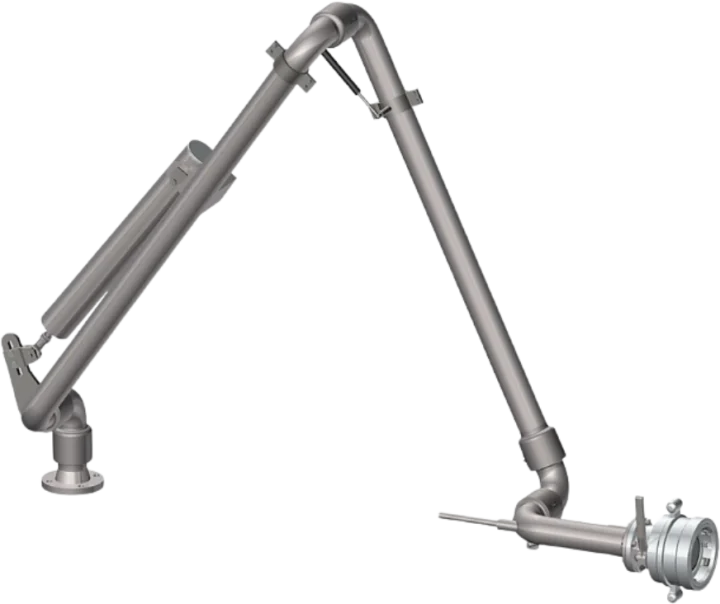
- Top Loading Arms: Ideal for loading or unloading tankers, railcars, and smaller containers like IBCs from the top. These are commonly used when access to the top of the container is available, and typically incorporate a vapour recovery riser alongside the product line.
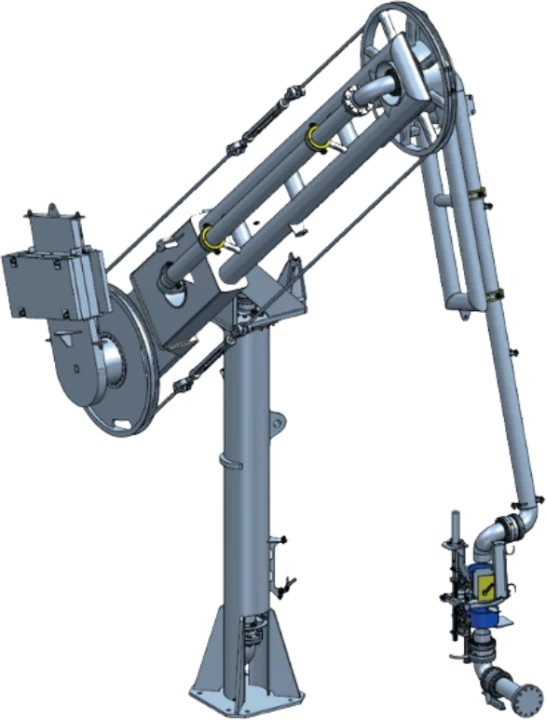
- Bottom Loading Arms: Connect to the underside of tankers or railcars, improving safety and efficiency by minimising vapour emissions and reducing operator exposure. These are especially common in petroleum and chemical industries, and are usually paired with a dry-break coupler to prevent spillage on disconnection.
3) Operating Environment
The environment where the Loading Arm will be used significantly influences design and material selection:
- Temperature and Weather: Outdoor systems must endure varying weather conditions, from intense heat and humidity to freezing temperatures. EWFM Loading Arms are engineered to maintain performance in even the harshest environments.
- Space Constraints: Limited space or complex site layouts may require custom designs, such as compact or articulated arms. EWFM can provide tailored solutions for even the most challenging spaces.
- Hazardous Areas: For operations in explosive or high-risk environments, ensure the Loading Arm meets safety certifications such as ATEX or equivalent standards, and consider whether earthing and bonding provisions are required to control static discharge.
4) Envelope, Reach and Swivel Joint Design
Beyond fluid type and configuration, the physical geometry of the arm needs to match your site:
- Working Envelope: The arm’s envelope defines the range of horizontal and vertical positions it can safely reach. This must be matched against the range of vehicle or vessel heights and connection points you need to service.
- Swivel Joints: These allow the arm to move freely while maintaining a leak-tight seal, and are typically the components most exposed to wear. The number and quality of swivel joints affects both flexibility and long-term maintenance cost.
- Counterbalance System: Spring or counterweight-balanced arms should hold position at any point in their envelope with minimal operator effort, an important factor for ergonomics and repeatability of connection.
- Line Size and Flow Rate: The internal bore of the arm must be sized correctly for your required flow rate; undersized arms create unnecessary pressure drop, while oversized arms add cost and reduce manoeuvrability.
5) Maintenance and Durability
Loading Arms are a long-term investment, so choose a system that is easy to maintain and built to last. EWFM’s Loading Arms are designed with minimal maintenance in mind, featuring durable components and easy-to-replace parts, such as seal kits that can be serviced without removing the entire arm from service. We also offer support and maintenance services to keep your equipment in top condition.

Frequently Asked Questions
What’s the difference between a top loading arm and a bottom loading arm? Top loading arms connect from above the tanker or container, while bottom loading arms connect to a valve on the underside of the vessel. Bottom loading is generally preferred for volatile or hazardous products because it reduces vapour emissions and operator exposure, though it typically requires more infrastructure to install. You can find out more about the different types of Loading Arms in our recent blog.
How do I know what materials my loading arm should be made from? Material selection depends primarily on the fluid being transferred. Corrosive chemicals call for stainless steel or lined arms, food-grade applications require hygienic stainless steel with approved seals, and standard petroleum products are often handled well with carbon steel or aluminium. Speak with our team for a recommendation specific to your product.
How often does a Loading Arm need to be inspected or serviced? This varies by application and local regulation, but as a general guide, a visual inspection before each use and a full mechanical and seal inspection at least annually is recommended. High-duty-cycle or hazardous-service arms may need more frequent checks.
Are Loading Arms compatible with existing tanker and railcar fittings? In most cases, yes, Loading Arms are typically supplied with a coupler or adaptor to match your existing fittings, such as camlock, dry-break, or API couplers. If you have non-standard connections, our engineering team will try to accomodate your requests.
How long does a Loading Arm typically last? With proper maintenance, a well-specified Loading Arm can remain in service for well over a decade. Lifespan depends on duty cycle, the corrosiveness of the product handled, and how consistently seals and swivel joints are serviced.
Conclusion
Selecting the right Loading Arm has a direct impact on the safety, efficiency, and profitability of your operations. By carefully considering factors such as fluid type, loading configuration, environmental conditions, envelope and swivel joint design, and maintenance needs, you can make a choice that supports both your current and future requirements.
At EWFM, we’re dedicated to helping you find the ideal Loading Arm solution. Contact us today to discuss your fluid transfer needs and discover how our innovative systems can enhance your operations.
